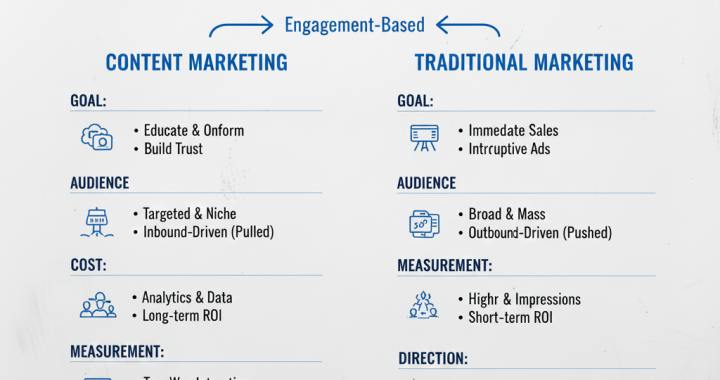
Marketing has always been an essential part of business growth. However, the way marketing works has changed dramatically over time. In the past, businesses relied heavily on traditional marketing methods such as television ads, newspapers, radio, hoardings, and flyers. Today, with the rise of the internet and digital platforms, content marketing has become one of the most powerful and preferred marketing approaches.
For beginners, understanding the difference between content marketing and traditional marketing is extremely important. Both methods aim to promote products and services, but they follow very different paths, strategies, and philosophies.
This blog explains what content marketing and traditional marketing are, how they work, and the key differences every beginner should know before choosing the right marketing approach.
1. What Is Traditional Marketing?
Traditional marketing refers to offline marketing methods that were widely used before the digital era. These methods focus on broadcasting promotional messages to a large audience through physical or mass media channels.
Common Types of Traditional Marketing
Television advertisements
Newspaper and magazine ads
Radio commercials
Billboards and hoardings
Pamphlets and brochures
Direct mail
Traditional marketing mainly focuses on reaching as many people as possible within a specific geographic area.
2. What Is Content Marketing?
Content marketing is a digital-first marketing approach that focuses on creating and sharing valuable, relevant, and informative content to attract and engage a specific audience.
Instead of directly selling, content marketing aims to:
Educate the audience
Solve problems
Build trust
Establish brand authority
Examples of content marketing include:
Blog articles
Videos
Social media posts
Infographics
Ebooks and guides
3. Core Philosophy: Push vs Pull Marketing
One of the biggest differences between content marketing and traditional marketing is their philosophy.
Traditional Marketing – Push Approach
Traditional marketing pushes messages to people whether they are interested or not. For example, TV ads interrupt programs, and flyers are distributed randomly.
Content Marketing – Pull Approach
Content marketing attracts people naturally by offering helpful information. Customers come to the brand because they find value in the content.
This difference makes content marketing more customer-friendly.
4. Audience Targeting and Reach Traditional Marketing Audience Targeting
Traditional marketing has limited targeting options. Ads are shown to a broad audience based on:
Location
Media channel
It is difficult to target specific interests or behaviors.
7. Measurement and Analytics Measuring Traditional Marketing
Measuring results in traditional marketing is challenging. Businesses rely on:
Surveys
Estimated reach
Sales impact guesses
Exact ROI is often difficult to calculate.
Measuring Content Marketing
Content marketing offers clear and measurable data, such as:
Website traffic
Engagement rates
Lead conversions
This helps businesses optimize strategies effectively.
8. Trust and Credibility Trust in Traditional Marketing
Traditional ads are often seen as promotional and biased. Customers know businesses are trying to sell.
Trust in Content Marketing
Content marketing builds trust by providing value before asking for a sale. Helpful content positions brands as experts.
Trust plays a major role in modern purchasing decisions.
9. Content Lifespan and Longevity Traditional Marketing Lifespan
Traditional ads have a short lifespan. Once the campaign ends, the visibility stops.
Content Marketing Lifespan
Content marketing offers long-term benefits. Blogs, videos, and guides can continue to:
Attract traffic
Generate leads
Build authority
This makes content marketing a long-term investment.
10. Customer Journey Support Traditional Marketing and Customer Journey
Traditional marketing mainly focuses on awareness and promotion.
Content Marketing and Customer Journey
Awareness
Consideration
Decision
Different content types guide customers smoothly toward conversion.
11. Personalization and Relevance Traditional Marketing Personalization
Personalization is limited in traditional marketing. Most messages are generic.
Content Marketing Personalization
Content marketing allows personalized messaging based on:
User behavior
Preferences
Search history
Personalization increases engagement and conversions.
12. Flexibility and Adaptability Traditional Marketing Flexibility
Content Marketing Flexibility
Content marketing is highly flexible. Businesses can:
Update content
Change strategies quickly
Test and improve continuously
This adaptability is crucial in the digital age.
13. Engagement and Interaction Traditional Marketing Engagement
Traditional marketing offers minimal engagement opportunities.
Content Marketing Engagement
Content marketing encourages:
Likes
Shares
Comments
Discussions
Engagement strengthens brand relationships.
14. SEO and Online Visibility Traditional Marketing and SEO
Traditional marketing has no direct impact on SEO.
Content Marketing and SEO
Content marketing strongly supports SEO by:
Creating keyword-rich content
Increasing website traffic
Improving search engine rankings
This enhances online visibility.
15. Comparison Table: Content Marketing vs Traditional Marketing Feature Content Marketing Traditional Marketing Approach Pull Push Cost Low to Medium High Targeting Highly specific Broad Interaction Two-way One-way Measurement Accurate Limited Trust High Medium Longevity Long-term Short-term 16. Which Marketing Is Better for Beginners?
It is affordable
It builds skills gradually
It delivers long-term results
However, traditional marketing may still be useful for local or mass-market branding.
17. Combining Content Marketing and Traditional Marketing
Traditional marketing for mass awareness
Content marketing for engagement and trust
This integrated approach maximizes results.
18. Common Mistakes Beginners Should Avoid
Relying only on traditional ads
Ignoring content quality
Expecting instant results from content marketing
Not tracking performance
Avoiding these mistakes ensures better outcomes.
19. The Future of Marketing
The future of marketing is moving toward:
Digital-first strategies
Personalized content
Value-driven communication
Final Thoughts
Content marketing is not just a trend—it is the future of marketing in the digital age.