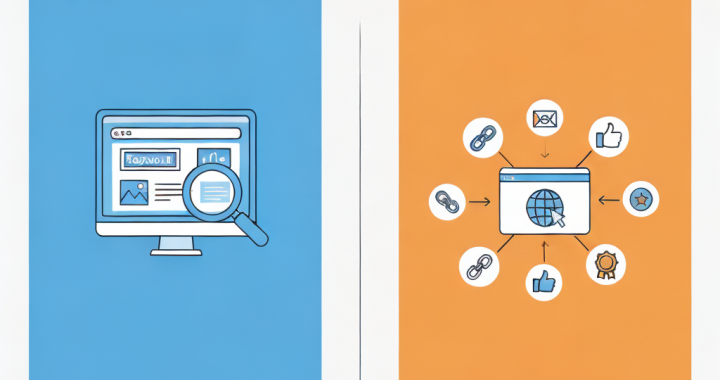
When beginners start learning SEO, they often come across two major terms: On-Page SEO and Off-Page SEO. While both aim to improve website visibility on search engines, they focus on very different areas.
Understanding the difference between on-page and off-page SEO is essential because successful SEO requires a balance of both. One cannot work effectively without the other. This blog explains what on-page and off-page SEO are, how they work, their key differences, and why both are critical for long-term search engine success.
1. What Is SEO and Why It Matters
SEO works because search engines aim to provide the most relevant and high-quality results to users. On-page and off-page SEO help search engines evaluate content quality, relevance, authority, and trustworthiness.
2. What Is On-Page SEO?
On-page SEO refers to all the optimization techniques that are applied directly on a website to improve its ranking. These factors are completely under the control of the website owner.
On-page SEO focuses on:
Content quality
Website structure
HTML elements
User experience
The main goal of on-page SEO is to help search engines understand what your content is about and why it is valuable to users.
3. Key Elements of On-Page SEO 3.1 High-Quality Content
Content is the foundation of on-page SEO. Search engines rank pages that provide valuable, informative, and original content.
Good content:
Answers user questions
Matches search intent
Is well-structured and readable
Quality content improves engagement and ranking potential.
3.2 Keyword Optimization
Keywords help search engines understand the topic of a page. Proper keyword placement includes:
Page title
Headings
Body content
URL structure
Keyword usage should be natural and relevant, not excessive.
3.3 Title Tags and Meta Descriptions
Title tags and meta descriptions appear in search results. They:
Improve click-through rates
Help search engines understand page topics
Well-optimized titles increase visibility.
3.4 URL Structure
A well-structured URL improves crawlability and relevance.
3.5 Internal Linking
Improve navigation
Help search engines crawl pages
Distribute link authority
Strong internal linking supports better rankings.
3.6 Page Speed and Performance
Fast-loading pages provide a better user experience. Slow websites can lose visitors and rankings.
3.7 Mobile-Friendliness
Search engines prioritize mobile-friendly websites. Responsive design ensures content looks good on all devices.
3.8 Image Optimization
Optimized images:
Improve page load speed
Enhance accessibility
Support SEO through alt text
3.9 User Experience (UX) Factors include:
Easy navigation
Readable content
Clear call-to-actions
Better UX leads to longer visit duration and improved rankings.
4. What Is Off-Page SEO?
Off-page SEO refers to all optimization activities performed outside your website to improve its authority and credibility.
Off-page SEO focuses on:
Building trust
Increasing brand reputation
Improving website authority
The main goal is to show search engines that your website is valuable, reliable, and recommended by others.
5. Key Elements of Off-Page SEO 5.1 Backlinks
They act as votes of confidence.
High-quality backlinks:
Increase domain authority
Improve rankings
Drive referral traffic
Quality matters more than quantity.
5.2 Domain Authority and Trust
Search engines evaluate how trustworthy a website is based on:
Link quality
Brand mentions
Content reputation
Trusted websites rank more easily.
5.3 Social Signals
While not direct ranking factors, social media activity helps:
Increase content visibility
Drive traffic
Build brand recognition
Engaged content often earns backlinks naturally.
5.4 Brand Mentions
Mentions of your brand name on other websites—even without links—help search engines recognize brand credibility.
5.5 Guest Posting
Guest posting involves writing content for other websites in exchange for exposure and backlinks.
5.6 Online Reviews and Reputation
Reviews influence trust and user decisions. Positive online reviews improve brand image and local SEO.
6. Differences Between On-Page and Off-Page SEO Aspect On-Page SEO Off-Page SEO Control Fully controlled Partially controlled Focus Website optimization Authority building Key Elements Content, keywords, UX Backlinks, reputation Timeline Faster improvements Long-term results Purpose Relevance Trust & authority
Both are equally important for SEO success.
7. How On-Page and Off-Page SEO Work Together
On-page SEO builds the foundation, while off-page SEO strengthens credibility. Even the best backlinks won’t help if the website content is poor. Similarly, great content may struggle without external validation.
Balanced SEO ensures:
Better rankings
Sustainable traffic
Higher conversions
8. Common Beginner Mistakes
Ignoring off-page SEO
Overusing keywords
Building low-quality backlinks
Neglecting content quality
Avoiding these mistakes improves long-term success.
9. Which One Is More Important?
Neither on-page nor off-page SEO is more important than the other.
For beginners:
Start with on-page SEO
Build quality content
Gradually focus on off-page SEO
10. Best Practices for Beginners On-Page SEO Tips
Focus on quality content
Use keywords naturally
Improve site speed
Optimize for mobile
Off-Page SEO Tips
Earn backlinks naturally
Focus on authority websites
Build a strong brand presence
11. Measuring SEO Success
SEO performance can be measured using:
Organic traffic
Keyword rankings
Engagement metrics
Conversion rates
Tracking helps improve strategy.
12. The Future of On-Page and Off-Page SEO
SEO will become more:
User-centric
Quality-focused
Trust-based
Both on-page and off-page SEO will remain essential.
If you want, I can also: 8. Common Beginner Mistakes
Ignoring off-page SEO
Overusing keywords
Building low-quality backlinks
Neglecting content quality
Avoiding these mistakes improves long-term success.
9. Which One Is More Important?
Neither on-page nor off-page SEO is more important than the other. On-page SEO ensures relevance, while off-page SEO ensures authority.
For beginners:
Start with on-page SEO
Build quality content
Gradually focus on off-page SEO
10. Best Practices for Beginners On-Page SEO Tips
Focus on quality content
Use keywords naturally
Improve site speed
Optimize for mobile
Off-Page SEO Tips
Earn backlinks naturally
Focus on authority websites
Build a strong brand presence
11. Measuring SEO Success
SEO performance can be measured using:
Organic traffic
Keyword rankings
Engagement metrics
Conversion rates
Tracking helps improve strategy.
12. The Future of On-Page and Off-Page SEO
SEO will become more:
User-centric
Quality-focused
Trust-based
Both on-page and off-page SEO will remain essential.
Final Thoughts
On-page and off-page SEO are two sides of the same coin. On-page SEO helps search engines understand your content, while off-page SEO builds trust and authority.
For beginners, mastering both concepts is the key to building a strong SEO foundation and achieving long-term digital success.